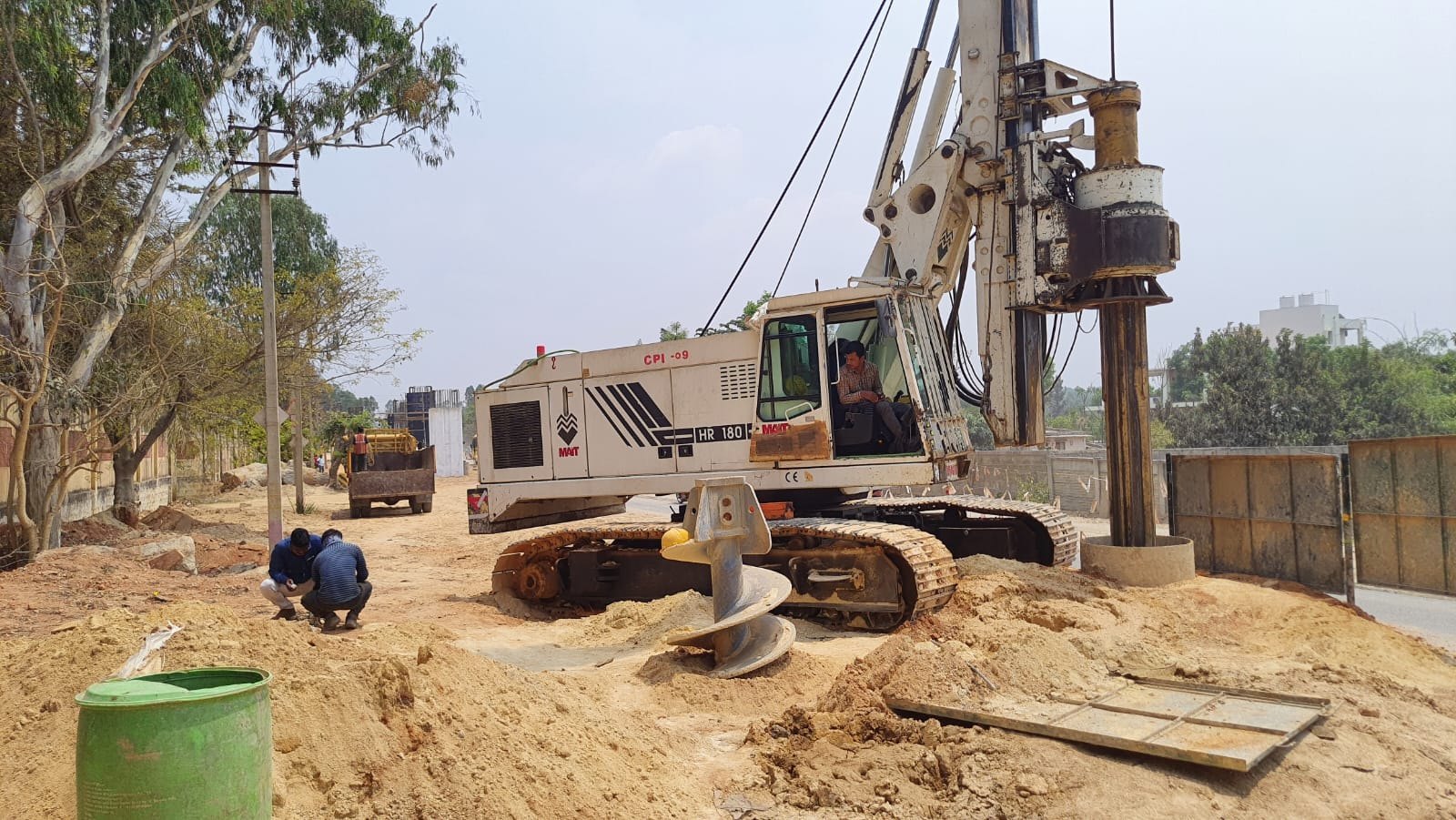

The foundation of a structure is its most critical component. It transfers loads from the building
to the ground and ensures long-term stability. In India, where soil conditions vary drastically
across regions from soft alluvial deposits in river basins to expansive black cotton soil and coastal
marine clays conventional shallow foundations are not always sufficient. In such cases, pile
foundations emerge as a reliable and safe solution.
Pile foundations are deep foundations that transfer structural loads to deeper, stronger soil layers
or bedrock. They are widely used in bridges, high-rise buildings, industrial structures, and marine
works in India. This article explores why pile foundations are necessary in Indian conditions and
the multiple advantages they provide.
What is a Pile Foundation?
A pile foundation consists of long, slender members known as piles driven, bored, or cast into the
ground to transfer loads. Piles can be made of concrete, steel, or timber, and they serve two
primary purposes:
1. End-bearing piles transfer load directly to hard strata or bedrock.
2. Friction piles transfer load by skin friction along their surface when hard strata is too deep.
Why Pile Foundations are Necessary in India
1. Varying Soil Conditions
India has diverse soil types:
• Alluvial soils in the Indo-Gangetic plains are soft and compressible.
• Black cotton soils in Maharashtra, Madhya Pradesh, and Gujarat swell during monsoons
and shrink in dry seasons, causing instability.
• Marine clays along coastal areas like Mumbai, Chennai, and Kolkata are weak and
unsuitable for shallow foundations.
• Desert soils in Rajasthan are sandy and prone to settlement.
In such regions, pile foundations bypass the weak upper layers and transfer loads to stronger
strata, ensuring stability.
2. Urbanization and High-Rise Construction
With rapid urbanization in cities like Mumbai, Delhi, and Bengaluru, demand for vertical growth
has increased. High-rise buildings exert heavy loads that cannot be supported by shallow
foundations on soft soils. Pile foundations are essential for such tall structures.
3. Infrastructure Development
India is investing heavily in infrastructure projects such as metro rail networks, flyovers, ports,
and bridges. These structures often cross rivers, marshlands, or reclaimed land, where pile
foundations are the only practical solution.
4. Flood-Prone and Seismic Zones
Large parts of India face floods (Assam, Bihar, Kerala) and earthquakes (Himalayan belt,
Northeast). Pile foundations offer greater stability in flood-prone zones by anchoring structures
deeper and resisting scour, while also improving seismic resistance by reducing differential
settlement.
5. Coastal and Marine Structures
Ports, harbors, and offshore oil platforms in India require pile foundations since the seabed soil is
usually weak. Piles resist lateral loads from waves, tides, and winds.
Advantages of Pile Foundations in India
1. Suitability for Weak Soils
Pile foundations are highly advantageous in soft clay, loose sand, or expansive soils. Instead of
depending on unreliable top layers, piles reach deeper, stable strata.
2. High Load-Bearing Capacity
Piles can carry very heavy loads sometimes thousands of tonnes. This makes them ideal for India’s
high-rise residential towers, industrial plants, and metro structures.
3. Resistance to Differential Settlement
In heterogeneous soil profiles, shallow foundations may settle unevenly. Piles distribute loads
more uniformly, reducing the risk of cracks and structural damage.
4. Adaptability for Waterlogged Areas
Many Indian cities, including Kolkata and Chennai, are prone to waterlogging. Piles can be driven
through saturated soils without losing strength, unlike shallow footings.
5. Durability
Reinforced concrete and steel piles have a long life and can resist chemical attacks from saline
soils in coastal belts such as Gujarat and Tamil Nadu.
6. Flexibility in Design
Piles can be grouped, spaced, or combined with pile caps to support various load configurations,
from residential blocks to long-span bridges like the Bandra-Worli Sea Link.
7. Seismic Performance
In earthquake-prone areas like Gujarat and Northeast India, pile foundations improve
performance by reducing amplification of ground vibrations and resisting lateral forces.
8. Support for Offshore and Marine Structures
Piles are essential in supporting India’s expanding port infrastructure, offshore wind farms, and
oil platforms, where traditional foundations are not possible.
9. Reduced Settlement in Reclaimed Land
Cities like Mumbai and Kochi have reclaimed land for construction. Piles ensure minimal
settlement in such unstable areas.
Case Examples from India
1. Bandra-Worli Sea Link, Mumbai
This iconic bridge stands on pile foundations that resist strong currents, tidal forces, and soft
marine soils of the Arabian Sea.
2. Delhi Metro Rail
Many metro piers stand on pile foundations, especially in areas with weak alluvial soils along the
Yamuna River.
3. High-Rise Towers in Mumbai
Skyscrapers in Mumbai, built on reclaimed coastal land, rely heavily on pile foundations to
prevent settlement.
4. Port Infrastructure
Major ports like Jawaharlal Nehru Port Trust (JNPT) and Chennai Port use pile-supported jetties
and berths.
Challenges and Considerations
While pile foundations offer numerous advantages, they also come with challenges:
• Cost: Piles are more expensive than shallow foundations.
• Specialized Equipment: Requires heavy machinery like pile drivers and rigs.
• Skilled Labor: Proper installation and supervision are essential.
• Time: Piling is a time-consuming process compared to simple shallow foundations.
Despite these challenges, the benefits outweigh the costs, especially in India’s difficult soil
conditions.
Future Outlook in India
As India continues rapid urbanization and infrastructure expansion, pile foundations will remain
central to construction:
• Smart Cities: High-rise commercial and residential complexes will increasingly adopt
piling.
• Metro Rail Expansion: Piles will be indispensable in extending metro networks across
Indian cities.
• Renewable Energy: Offshore wind farms and solar parks in coastal belts will require pile
supported structures.
• Coastal Protection: With rising sea levels, pile foundations will be critical in building
resilient coastal infrastructure.
Conclusion
Pile foundations are not just an engineering option but a necessity in many parts of India. The
country’s varied soil conditions, increasing demand for high-rise buildings, expansion of transport
and port infrastructure, and exposure to natural hazards make pile foundations the most
dependable solution.
Their ability to provide stability in weak soils, resist seismic and flood forces, and support massive
loads gives them an unmatched advantage. Although they demand higher costs and technical
expertise, their long-term benefits in safety, durability, and adaptability make pile foundations
the backbone of modern construction in India.
Leave a Reply